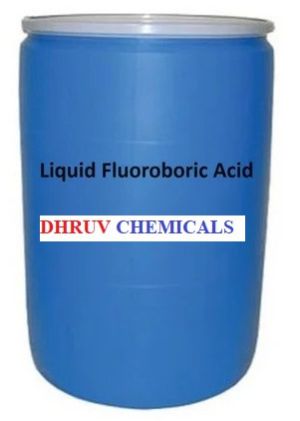
- Kandivali, Mumbai, Maharashtra
- View Mobile Number
dcdhruvchemicals@gmail.com

| Business Type | Manufacturer, Exporter, Supplier |
| Brand Name | Indian |
| Application | Commonly Used In Metal Surface Treatment And Electroplating Processes |
| CAS No. | 16872-11-0 |
| Click to view more | |
Product Details
Purity
High Purity
Country of Origin
India
Type
Chemical Compound
Material
Fluoboric Acid
Color
Colorless To Pale Yellow
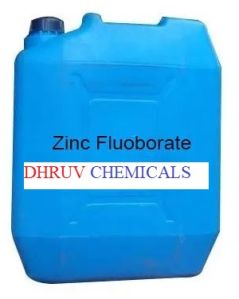
Packaging
Typically Comes In Plastic Or Glass Containers
Formula
HBF4
Delivery Time
4 to 6 days
Packaging Details
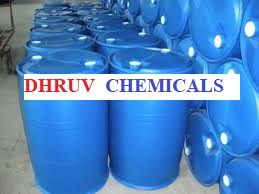
30 kgs drum and 50 kgs drum
Fluoroboric acid (also known as tetrafluoroboric acid or hydrofluoboric acid) is a strong inorganic acid composed of the tetrafluoroborate anion ($\text{BF}_4^-$) and a proton ($\text{H}^+$). It exists commercially almost exclusively as an aqueous solution (typically $40-50\%$ concentration) because pure, anhydrous $\text{HBF}_4$ is unstable.
Key Chemical & Physical Properties
| Property | Specification / Value |
| Chemical Formula | $\text{HBF}_4$ |
| CAS Registry Number | 16872-11-0 |
| Molar Mass | $87.81\text{ g/mol}$ |
| Appearance | Clear, colorless liquid |
| Density | $\sim1.28 - 1.40\text{ g/cm}^3$ (for $40-50\%$ aqueous solutions) |
| Boiling Point | $\sim130^\circ\text{C}$ (decomposes) |
| Acidity ($\text{p}K_a$) | $-4.9$ (Strong acid, fully ionized in water) |
| Solubility | Fully miscible with water and alcohols |
-
Non-Coordinating Anion: The tetrafluoroborate anion ($\text{BF}_4^-$) is weakly coordinating, making fluoroboric acid ideal for preparing metal salts with reactive cations or generating free carbonium ions in organic synthesis.
-
Etching & Cleansing Capability: Dissolves metal oxides and silica without the extreme volatility and hazards of concentrated hydrofluoric acid ($\text{HF}$).
-
Thermal Decomposition: Upon heating, aqueous fluoroboric acid decomposes into water, boron trifluoride gas ($\text{BF}_3$), and hydrofluoric acid ($\text{HF}$).
-
Electroplating & Metal Surface Treatment: Widely used in tin, lead, copper, and alloy electroplating baths to prepare smooth, corrosion-resistant metallic coatings.
-
Organic Synthesis & Catalysts: Serves as an acid catalyst in alkylation, polymerization, and esterification reactions, as well as in the synthesis of diazonium tetrafluoroborate salts (used in the Schiemann reaction to prepare aryl fluorides).
-
Aluminum & Glass Processing: Used as a flux constituent, oxide-stripping agent, and surface cleaning agent prior to soldering or plating.
-
Preparation of Tetrafluoroborate Salts: Primary precursor for synthesizing various fluoroborate salts (such as sodium, potassium, or ammonium tetrafluoroborates).
-
Corrosive Hazard: Highly corrosive to skin, eyes, and metals (UN 1775, Hazard Class 8).
-
Storage Warning: Slowly attacks standard glass over long storage periods due to trace equilibrium $\text{HF}$. It must be stored in specialized plastic containers (HDPE, polypropylene, or fluoropolymers).
-
HSN / HS Code: 2811 19 90 (or 2810 00 20 in specific inorganic tariff schedules)
-
IUPAC Name: Hydrogen tetrafluoroborate
-
GST Rate (India): 18%
Looking for "Fluoboric Acid" ?
Kilogram